
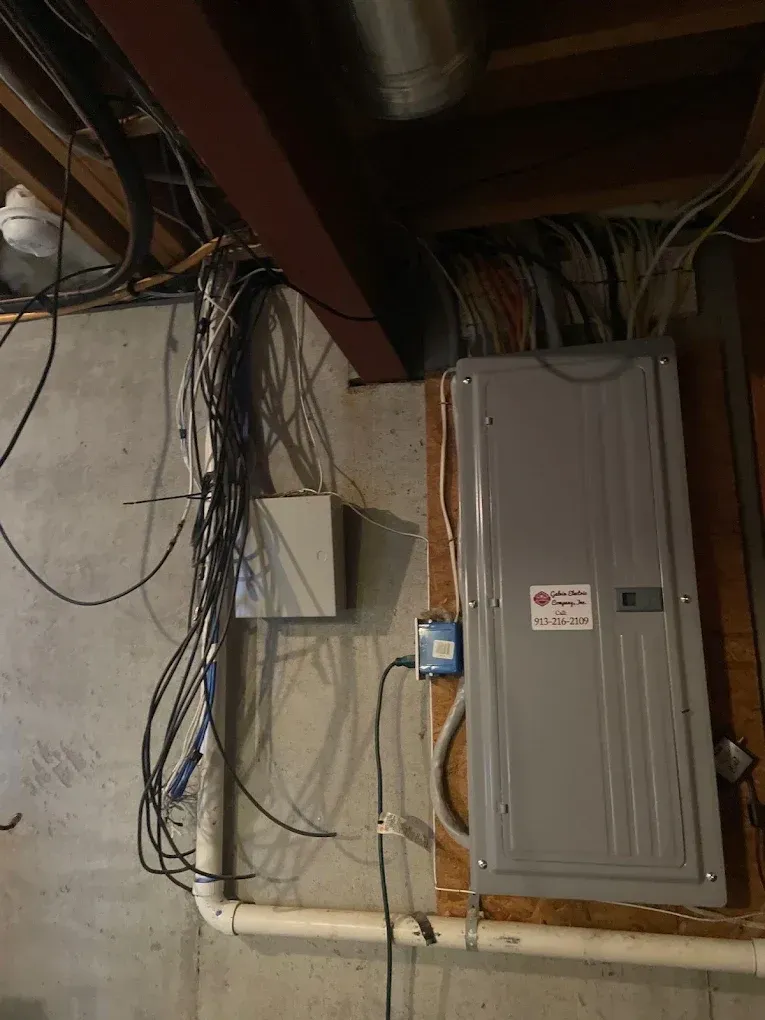
Faults Found, Diagnosed, and Corrected Completely
Electrical Wiring Repair in Kansas City for burning smells, tripping breakers, dead outlets, or circuits that fail under load
Burning plastic near an outlet, a breaker that trips repeatedly under normal load, or a circuit that goes dead without explanation are not inconveniences—they are indicators of a wiring fault that poses a fire or shock risk until it is located and corrected. Galvin Electric Company, Inc. performs electrical wiring repair in Kansas City, using testing equipment to locate opens, shorts, grounds, and overloaded circuits before any repair work begins. Diagnosing the fault precisely is what determines whether a repair involves a single splice inside a junction box or a complete circuit replacement.
The diagnostic process uses instruments that identify resistance changes, voltage drops, and ground faults at the circuit level, narrowing the problem to a specific section of wire or connection point rather than requiring wall demolition to trace the run by sight. Once the fault is located, the repair may involve splicing wire inside a properly covered junction box with rated connectors, replacing a breaker that has failed under repeated overload, tightening loose lugs at the panel where conductors have backed out over time, or running a new circuit if the existing wiring cannot be safely restored. The approach is determined by what the testing reveals, not by a default repair method.
Contact Galvin Electric Company, Inc. to schedule a diagnostic visit when a circuit is behaving abnormally or a burning smell has been noticed near any outlet, switch, or panel location.
What Wiring Repair Actually Accomplishes
Older homes and commercial buildings in areas like Lee's Summit and Gladstone develop wiring faults from multiple sources—conductor insulation that has degraded over decades, connections that have loosened from thermal cycling as circuits heat and cool under load, and repairs made by prior owners that used incorrect splicing methods or undersized wire for the circuit's demand. Animal damage in attic and wall spaces adds another category of fault that produces the same symptoms but requires a different repair sequence because the damaged section must be located and the new wire routed around the affected area.
After the repair is complete, the circuit should hold its rated load without tripping, the outlet or switch at the affected location should function at full voltage, and any burning smell or discoloration around outlets should not recur. Those observable points confirm that the fault was identified correctly and the repair addressed the actual condition rather than an adjacent symptom. A repair that clears a breaker trip without identifying the underlying fault will produce the same failure again under load.
Galvin Electric Company, Inc. offers five documented service plans for ongoing electrical maintenance, which is relevant for property owners managing older buildings where wiring faults recur as more of the original system ages past its useful service life. Periodic evaluation of the panel and high-use circuits is more cost-effective than addressing each failure individually as it develops.
Questions Before Starting Your Project
The questions below address how wiring faults are diagnosed and repaired—what the process involves, what drives the repair decision, and what you can observe once the work is done.
How does an electrician locate a wiring fault without opening every wall?
Testing equipment measures resistance, voltage, and continuity at accessible points along a circuit, which allows the technician to narrow the fault to a section of wire or a specific connection point. In most cases the fault location can be identified without removing finished wall surfaces, reducing the repair to a targeted intervention rather than a full-wall trace.
What causes wiring faults in older Kansas City homes and commercial buildings?
The most common causes in older construction are insulation degradation on conductors that have been in service for fifty or more years, connections that have loosened from thermal cycling at the panel or junction boxes, and prior repairs that used undersized wire or improper splice methods. Animal damage in attic spaces is an additional source that produces similar symptoms but requires a different access and routing approach.
When does a wiring fault require a full circuit replacement rather than a targeted repair?
If testing shows the conductor insulation has degraded across a significant portion of the run, or if the wire gauge used for the original circuit is undersized for the load it serves, a splice repair at the fault point does not resolve the underlying condition. In those cases a new circuit is run from the panel using correctly sized wire and installed in accordance with current code.
What is the correct way to splice a wire during a wiring repair?
Splices are made inside a junction box using connectors rated for the wire gauge and circuit type, and the box is covered with a listed cover plate that remains accessible for future inspection. Open splices inside wall cavities without a junction box do not meet code and are a common finding in homes where prior repairs were done without a permit.
How do you confirm a wiring repair was successful before the job is finished?
The repaired circuit is tested under load to verify it holds without tripping, voltage is measured at affected outlets to confirm full delivery, and any discoloration or thermal marking at the fault location is documented as resolved. A circuit that passes under load testing at the conclusion of the repair is the baseline confirmation that the fault was addressed correctly.
Galvin Electric Company, Inc. is licensed in Johnson County and Kansas City and handles wiring repair across both residential and commercial properties in the area. Galvin Electric Company, Inc. also performs wiring repair in Overland Park, Lenexa, Lee's Summit, Olathe, and Belton. To begin, schedule a diagnostic visit so the fault can be located and the correct repair approach identified before any work is quoted or started.