Dead Outlets Have a Cause Worth Finding
Electrical Outlet Repair in Kansas City for outlets that are dead, loose, sparking, or no longer holding a plug securely
An outlet that stops working or holds a plug loosely is pointing to one of three distinct failure types, and the right repair depends entirely on which one is present. Galvin Electric Company, Inc. diagnoses and repairs electrical outlets for Kansas City homeowners, beginning with live-current testing to confirm whether the failure is in the outlet's internal contacts, the terminal wiring inside the box, or a tripped protective device upstream. Treating every dead outlet as a simple replacement without confirming the source of the fault often leaves the underlying problem in place.
The repair process at Galvin Electric starts with testing for live current at the outlet and at the panel to isolate the failure point. Loose wiring at the terminal screws—a common condition in Kansas City homes built before the 1990s, when back-stab wiring connections were standard and tend to fail over years of thermal cycling—is corrected by rewiring to the screw terminals before the new outlet is seated. If the outlet itself has failed internally, the contacts no longer grip the plug blades with enough pressure to maintain a stable connection, which shows up as intermittent power or a plug that falls out under its own weight. Diagnosis and replacement are completed in one visit.
Arrange an outlet inspection with Galvin Electric to confirm whether the failure is in the device, the wiring, or the circuit it connects to.
What Outlet Replacement Actually Involves
Replacing an outlet correctly requires more than swapping the device. The technician verifies that the wiring gauge in the box matches the outlet's amperage rating, checks that the ground wire is connected and continuous to the panel, and confirms the box has enough depth and fill space to accept the new device without crowding the conductors. In kitchen and bathroom locations, current electrical code requires GFCI protection—either a GFCI outlet at the affected location or a GFCI breaker protecting the circuit—and Galvin Electric installs whichever configuration is appropriate for the existing wiring layout.
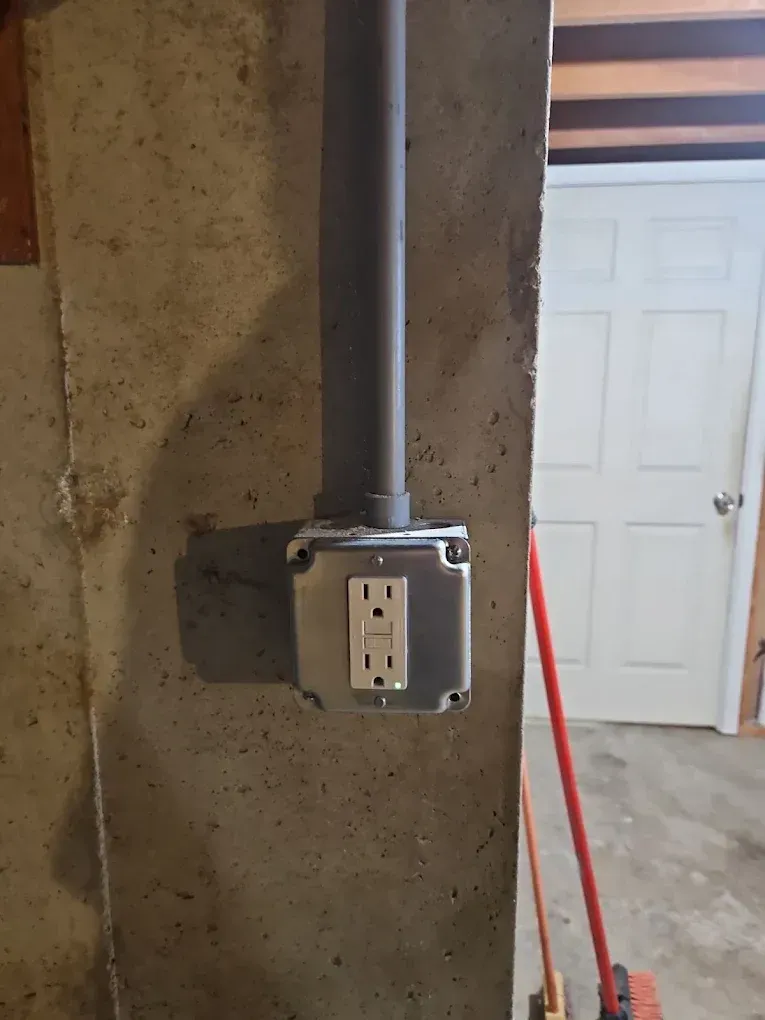
Once the outlet is replaced and the cover plate is seated, the visible result is an outlet that holds plugs firmly, shows no discoloration or scorch marks around the face, and tests correctly for hot, neutral, and ground continuity. Outlets in wet areas will have a test and reset button that responds correctly, confirming the GFCI function is active. Galvin Electric confirms correct function at every outlet repaired before the job is closed.
Outlet repairs vary in complexity depending on what the inspection reveals—some locations require only a device replacement while others involve rewiring the box or adding a GFCI device to bring the location into compliance with current code. Both scenarios are resolved in a single visit without requiring panel work unless the circuit itself has a fault.
Answers About How Outlet Repair Works
The following questions cover the repair process itself—what causes outlets to fail, how the work is performed, and what a correctly completed repair produces in Kansas City homes where outlet conditions vary by construction era.
Why would an outlet stop working even though the breaker hasn't tripped?
A GFCI outlet elsewhere on the same circuit may have tripped and cut power to all outlets downstream of it—pressing the reset button on that GFCI device will restore power without any panel involvement; if no tripped GFCI is present, the outlet's internal contacts or terminal wiring have failed and the device needs replacement.
What is a GFCI outlet and how does it differ from a standard outlet?
A GFCI outlet contains a sensor that detects current imbalance between the hot and neutral conductors—a condition that occurs when current is leaking to ground through a person or a wet surface—and interrupts power within milliseconds; standard outlets have no such protection and are not permitted by code in kitchens, bathrooms, or other wet-area locations.
How does a technician confirm whether the outlet or the wiring is the source of the failure?
Testing with a non-contact voltage tester at the outlet face confirms whether live current is reaching the device; if current is present but the outlet still doesn't work, the internal contacts have failed and the device is replaced; if no current reaches the face, the fault is in the wiring or upstream protection.
What makes back-stab wiring connections a problem in older Kansas City homes?
Back-stab connections push the conductor into a spring-loaded hole in the back of the outlet rather than wrapping it around a screw terminal; those spring contacts weaken over time, creating a high-resistance connection that causes heat buildup, intermittent power, and eventual failure—rewiring to screw terminals during replacement eliminates this failure mode.
What does correctly finished outlet work look like after the technician leaves?
The outlet face sits flush against the wall with no gap around the cover plate, plugs seat firmly without wobbling, and a plug-in outlet tester shows correct wiring polarity and a functioning ground—these three indicators confirm the repair was done to standard.
Galvin Electric Company, Inc. is prepared to assess the outlet condition and complete the repair in one visit to your Kansas City property. Galvin Electric also performs electrical outlet repair in Overland Park, Lenexa, Lee's Summit, Olathe, and Belton.