
Ceiling Boxes, Switch Circuits, and Safe Connections
Ceiling Fan Installation in Kansas City for boxes that cannot support fan weight, missing switch circuits, or unsafe wiring conditions
Galvin Electric Company, Inc. handles ceiling fan installation in Kansas City, covering the structural, wiring, and switching requirements that separate a safe installation from one that creates fire or injury risk. Many homeowners assume swapping a light fixture for a fan is straightforward, but the ceiling box must be rated for the dynamic load a rotating fan produces—a standard light fixture box is not. That distinction alone determines whether the fan stays securely mounted or pulls free over time.
Before any wiring begins, the installer confirms the ceiling box is rated for fan weight and is fastened to framing or a purpose-built brace—not simply anchored to drywall. If a dedicated switch circuit does not already exist at that location, new wiring is run from the panel to support independent control of the fan motor and light kit. Connections at the fan are made according to manufacturer specifications, which matter both for safety and for preserving any factory warranty on the unit.
Schedule an on-site evaluation to confirm box support and circuit availability at your specific ceiling location before any equipment is purchased.
What Proper Ceiling Fan Installation Requires
After the fan is wired and mounted, it is balanced and tested before the job is considered complete. An out-of-balance fan wobbles under load, stresses the mounting hardware, and produces noise that worsens over time. Balancing involves checking blade pitch consistency and, when needed, using a balancing kit to correct minor manufacturing variation in the blade set. Galvin Electric Company, Inc. does not hand off a running fan until that test is done.
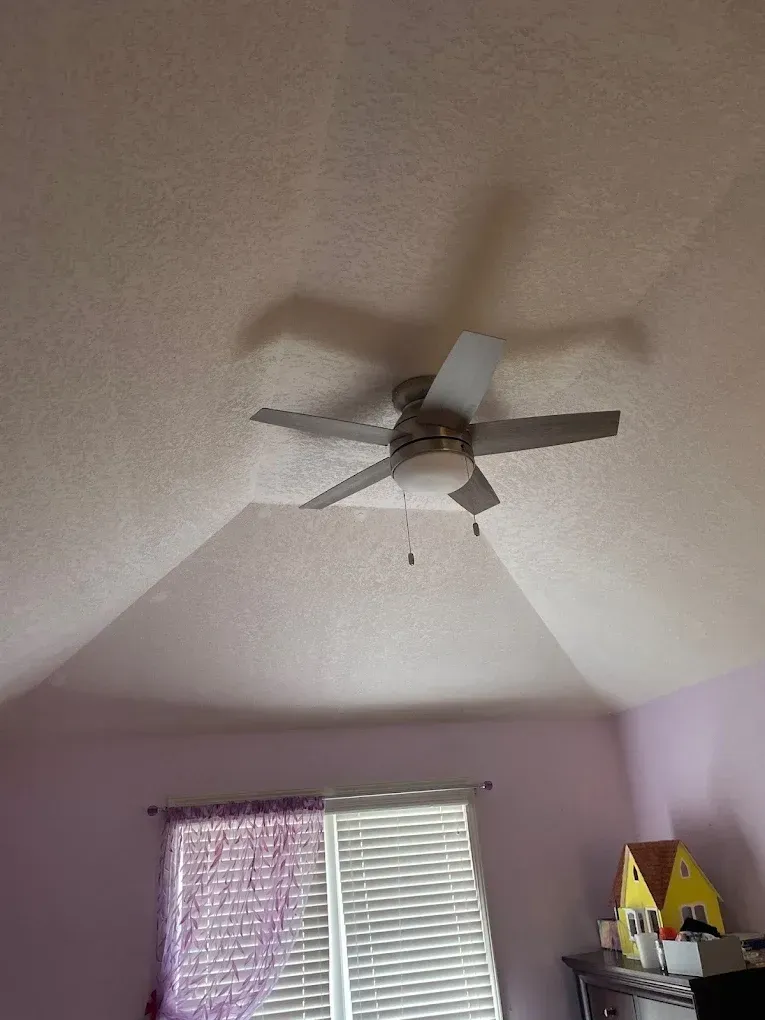
Once the installation is finished, you will notice the fan runs without wobble at all speed settings, the switch controls operate as intended, and the ceiling box shows no movement or flex when the motor is running. Those are the observable checkpoints that confirm the structural and electrical work was done correctly—not just that the fan turns on.
Homes in areas like Lenexa with older construction often have ceiling boxes installed decades ago that met the code standard of the time but are not rated for today's heavier fan models. If your home was built before current fan-rated box requirements were standard, the box itself may need to be replaced before the new fan can be safely hung—this is assessed during the initial visit, not after the fan is already unboxed.
Common Questions About Ceiling Fan Installation
The questions below cover how ceiling fan installation actually works—what affects the approach, what the installer checks, and what you can verify once the work is complete.
What has to be confirmed before a ceiling fan can be installed where a light fixture currently exists?
The existing ceiling box must be inspected for its load rating and how it is fastened—fan-rated boxes are required to handle the dynamic weight of a spinning motor, and a standard fixture box fastened only to drywall will not qualify. If the box fails that check, it is replaced before the fan is mounted.
How is a new switch circuit run when one does not already exist at the fan location?
Wire is routed from the electrical panel to the switch location and up to the ceiling box, following the most direct path that minimizes wall disruption. The circuit is sized to the fan's electrical requirements and connected to a properly rated breaker at the panel.
What does it mean to balance a ceiling fan, and why does it matter?
Balancing adjusts for blade pitch inconsistencies that cause wobble at speed, which stresses mounting hardware and shortens the life of the motor bearings. A balanced fan runs quietly and puts even load on the ceiling box rather than cyclic stress that loosens fasteners over time.
How does adding a light kit to a ceiling fan affect the wiring?
A fan with an integrated light kit requires wiring that supports both the motor circuit and the light circuit, which may call for a two-conductor or three-conductor cable depending on whether separate wall controls are used for each function. The wiring configuration is determined by the fan model's wiring diagram before connections are made.
What should you check in the finished installation to confirm the work was done correctly?
At all three speed settings the fan should run without visible wobble, the ceiling box should show no flex or movement when the motor is operating, and every switch control should function as labeled. Those three points together confirm both the structural mount and the electrical connections are correct.
Galvin Electric Company, Inc. is licensed in Kansas City and Johnson County and installs ceiling fans across the residential base in both areas. Galvin Electric Company, Inc. also installs ceiling fans in Overland Park, Lenexa, Lee's Summit, Olathe, and Belton. To move forward, request an on-site visit so the ceiling box and existing wiring at your specific location can be assessed before installation begins.